Acts 3 and 4: run the federation, then fight for the town
Last time you could play Hedy Plant on this site, the game ended when you freed the ninth plant. Now it keeps going for two more acts. Act 1 also gets a new temptation, act 2 explains itself, and the whole game gets pictures so it's no longer a wall of text.
Act 3: keeping it is the hard part
Your nine plants are now a federation of worker co-ops, loosely modeled on Mondragon. Every few minutes the federation closes its books and the members decide how to split the surplus. You start new co-ops, get through a recession, and face everyone who would rather you didn't exist: the banks, a "Main Street" coalition with a bill to keep towns from buying from co-ops, and a private equity firm that keeps offering to buy the members out.
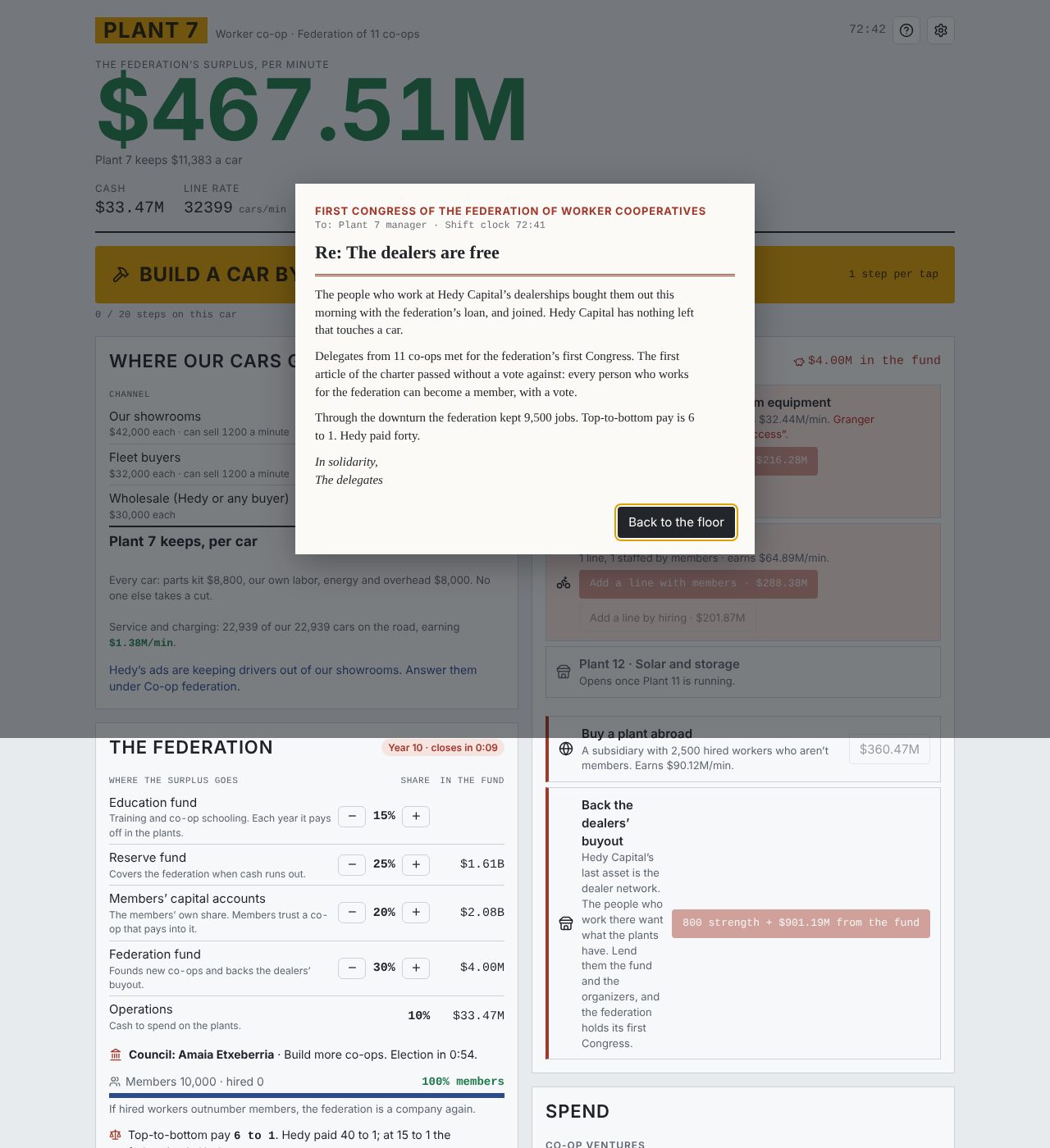
You can win the federation's First Congress. Or you can grow the cheap way, by hiring workers who don't vote, and quietly turn into Hedy.
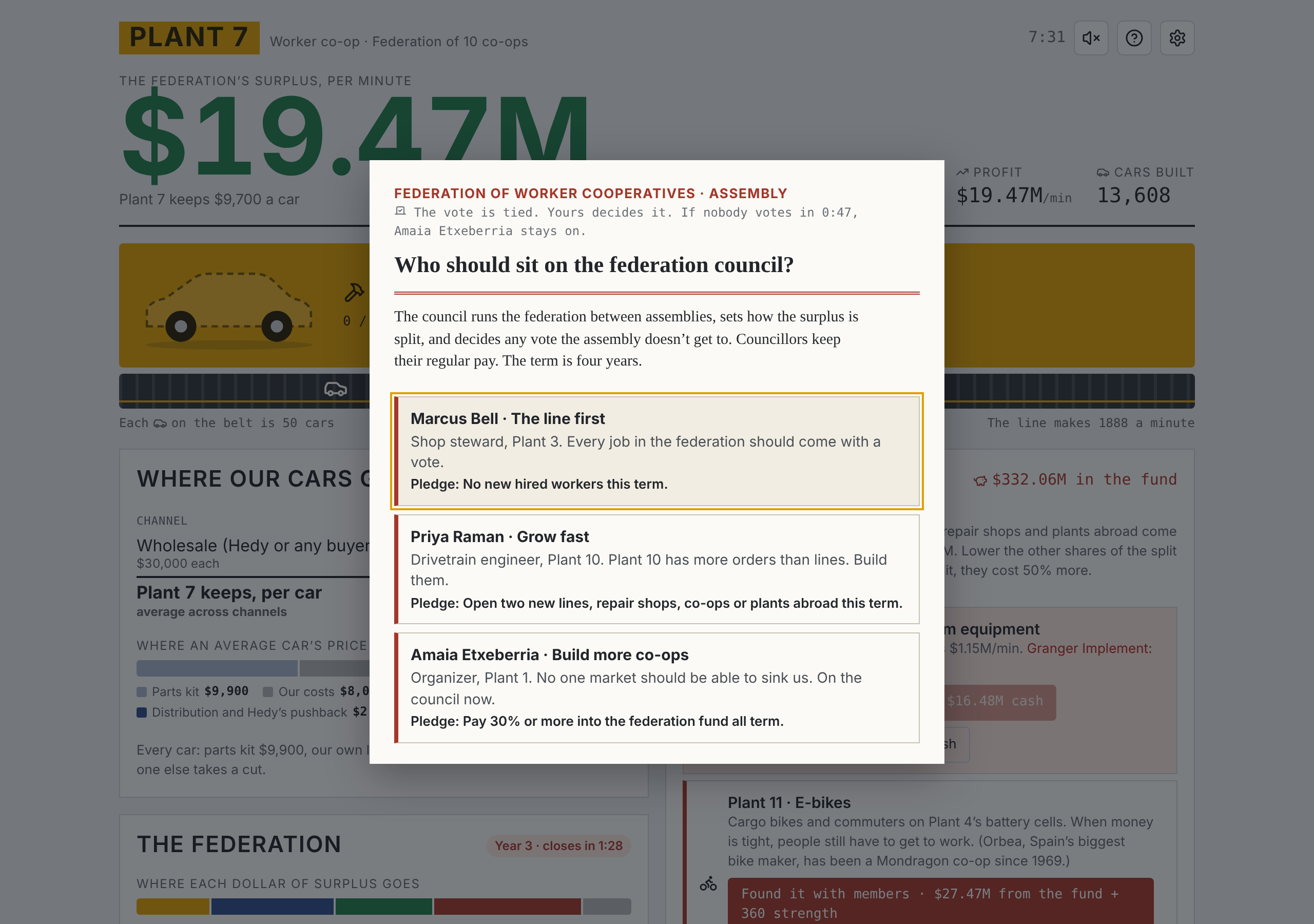
Elections that matter. The members elect a council, and the council sets the split of the surplus at each year close. Candidates come from a rotating pool, and each one runs on a pledge, like "no new hired workers this term" or "pay 30% or more into the federation fund." You can propose an amendment to the council's budget, but it only passes if the members trust you, and a failed one costs trust. Let trust fall below 55 and members can recall a councillor.
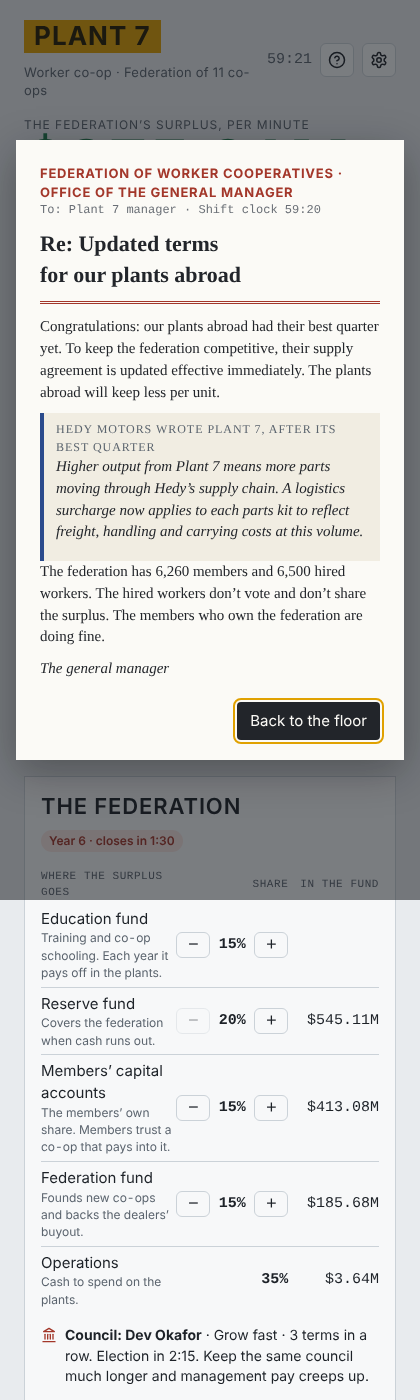
Trust now follows what the federation actually does. Pay members into their capital accounts, keep top-to-bottom pay narrow and keep hired workers few, and trust climbs. Do the opposite and it falls, and a federation that doesn't trust its leadership organizes less and turns out less.
Growing by hiring is always cheaper and always faster. If hired workers ever outnumber members, or top-to-bottom pay reaches 15 to 1, the federation is just a company again, and the game says so. That's the trap.
Act 4: The Rent
You won. Pay is up. Then a landlord called Ridgeline Homes starts buying up the neighborhoods your members live in.
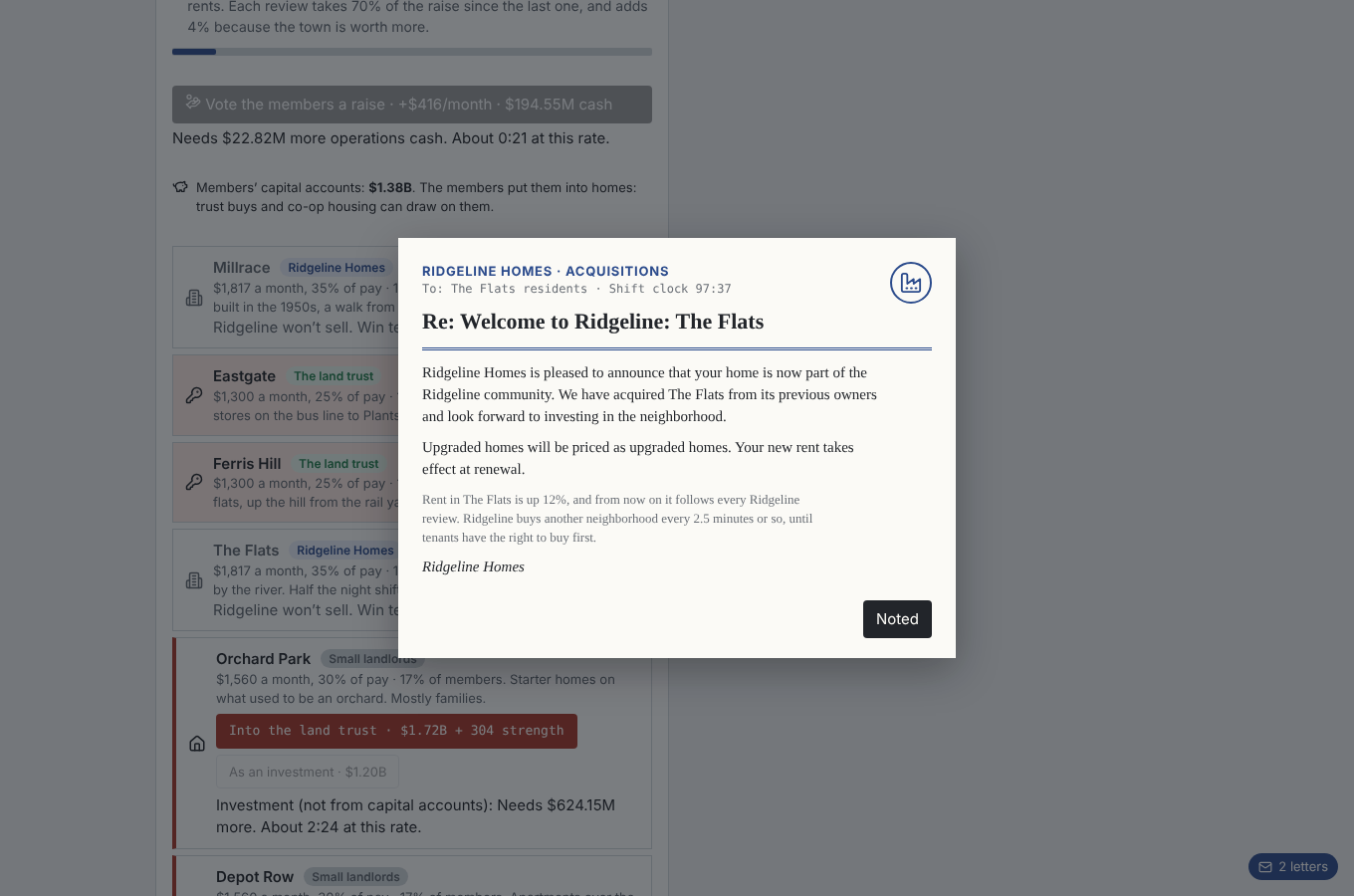
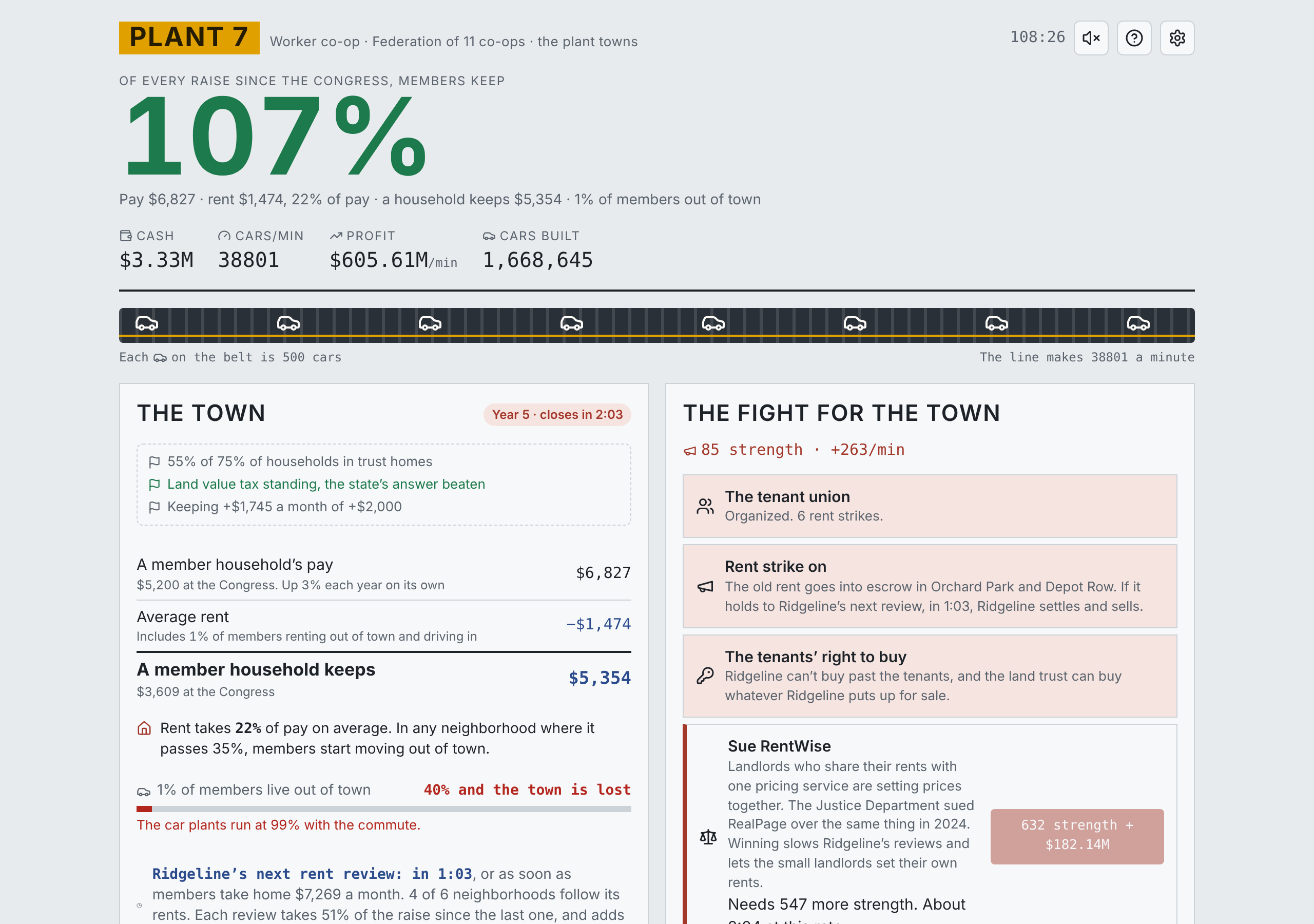
Every raise the members vote themselves brings a Ridgeline rent review, and each review takes a share of the raise. So the big number at the top of the screen asks one question: of every raise since the Congress, how much do members actually keep?
To keep it, you organize the town. You can put neighborhoods into a land trust and build co-op housing on it, organize a tenant union and call rent strikes, win tenants the right to buy first, sue the rent-pricing software, and pass a land value tax. Members can put their own savings into the land too, but only if the assembly votes for it. If rents push 40% of your members out of town, you lose.
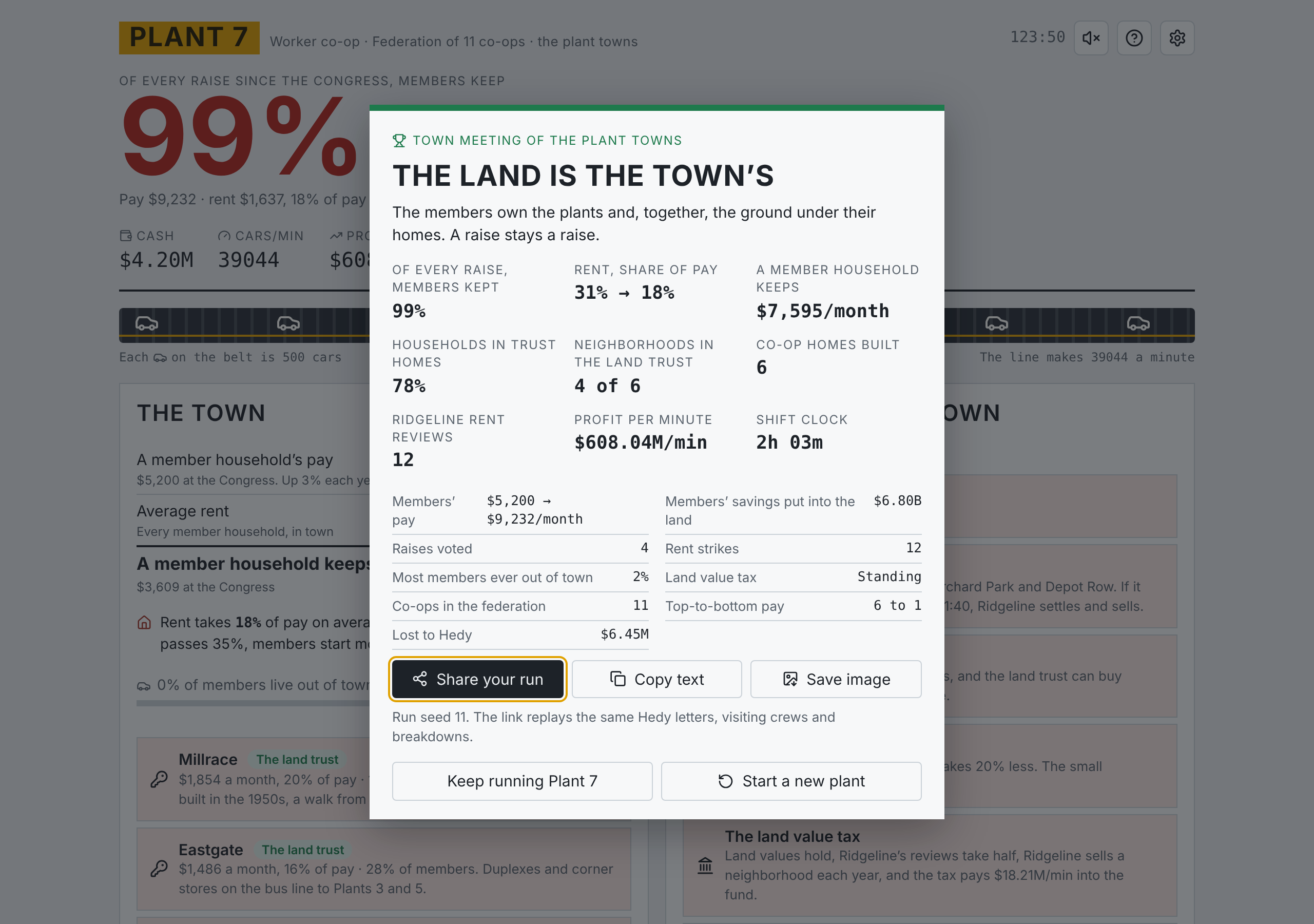
Win and the town meeting declares that the land belongs to the town. There's also a second, bitter ending: the federation buys the neighborhoods as investments and becomes the landlord.
We had four AI playtesters run act 4 before this release. They found it far too easy, because one pile of capital could buy half the town in about 80 seconds. Every fix they suggested is in this build. (Here's how and where we use AI in making these games.)
Act 1: mandatory overtime
In act 1 you're a plant manager getting squeezed by Hedy, and until now every lever you had cost money. Now there's one that doesn't.
Once you have three workers, a Mandatory overtime card shows up under Crew. Turn it on and your line workers build 50% more, for free. It's genuinely the best move you can make, for about five minutes.
Then the crew wears down. The bonus shrinks to 10%. People start quitting, and every one who leaves makes the next hire more expensive. Injuries double the line stoppages. The extra cars bring Hedy's next price review sooner. And once organizing is open, a worn-out crew starts bringing in strength on its own.
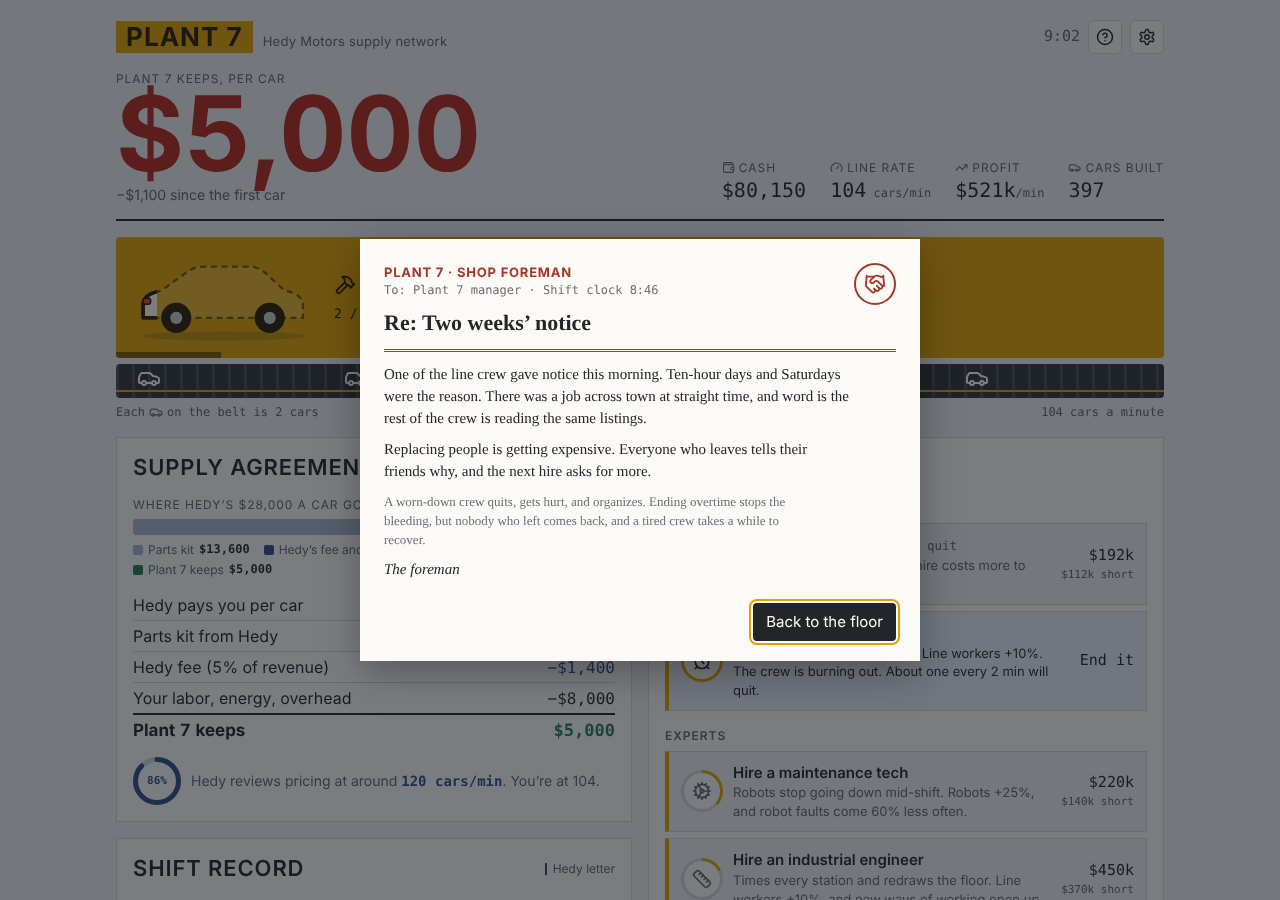
You can end it any time. The quitting stops, but the crew takes ten minutes to recover and nobody who left comes back. In our test runs, overtime for the first five minutes puts you about 8% ahead. Leave it on and you're 7% behind by minute 10 and 15 to 20% behind by minute 20. Buying the plant out ends it for good.
Act 1: no more parking under Hedy's radar
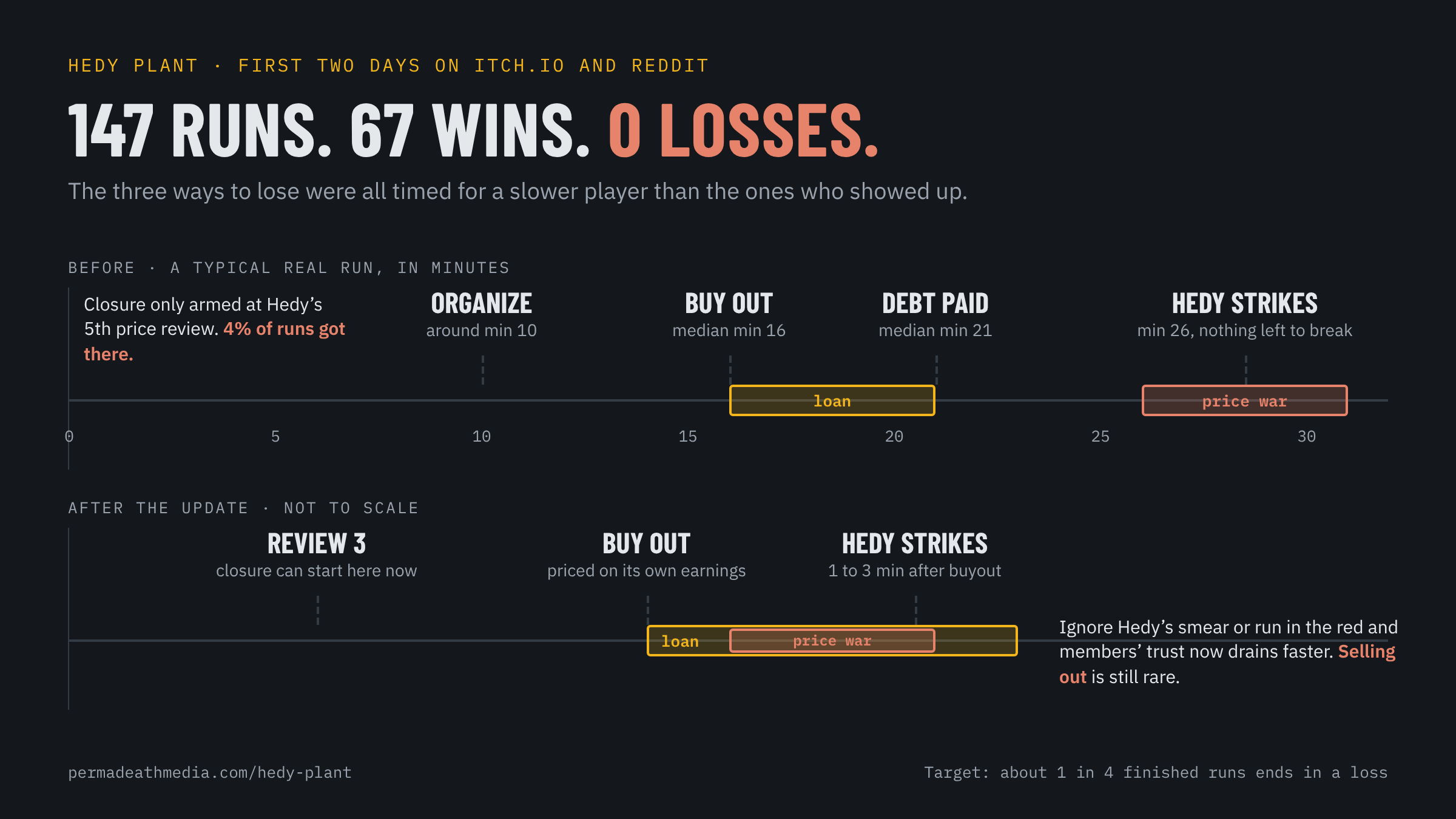
Some of you found a quiet trick: take Hedy's first letter or two, then stop growing just under the next review. Hedy never wrote again, and you walked into the buyout with tens of millions saved and nothing to fear in act 2.
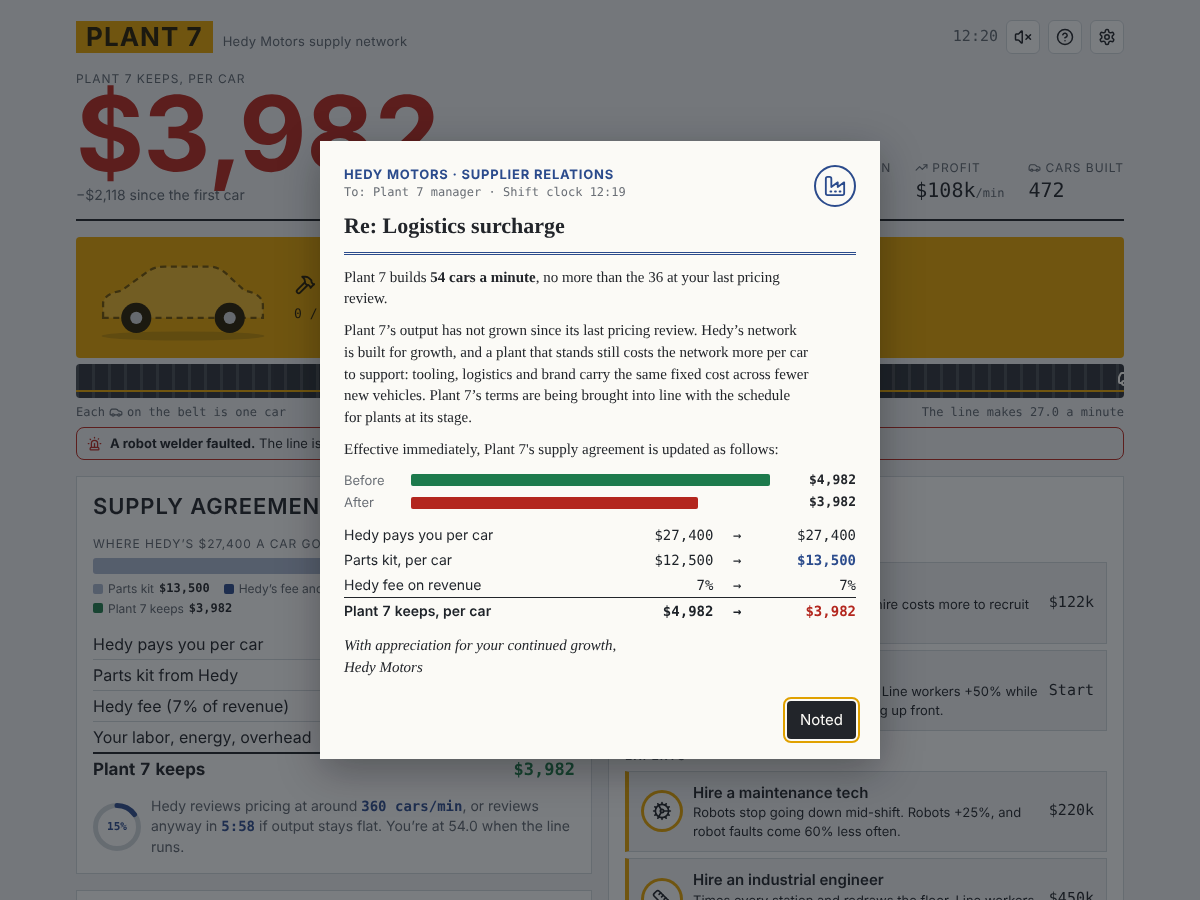
Not anymore. After the first letter, the Supply Agreement panel now shows a second clock: if your output stays flat for six minutes, Hedy reviews your pricing anyway, because "a plant that stands still costs the network more per car to support." If you've signed a federation agreement, the same clock voids it instead, and the closure threat comes back. Keep growing and you'll never see the clock. Grow and get squeezed, or stall and get squeezed: there's no parking spot under Hedy.
A car you build by hand, and pictures for the numbers
Beta players told us each column was a wall of text, and they were right. So:
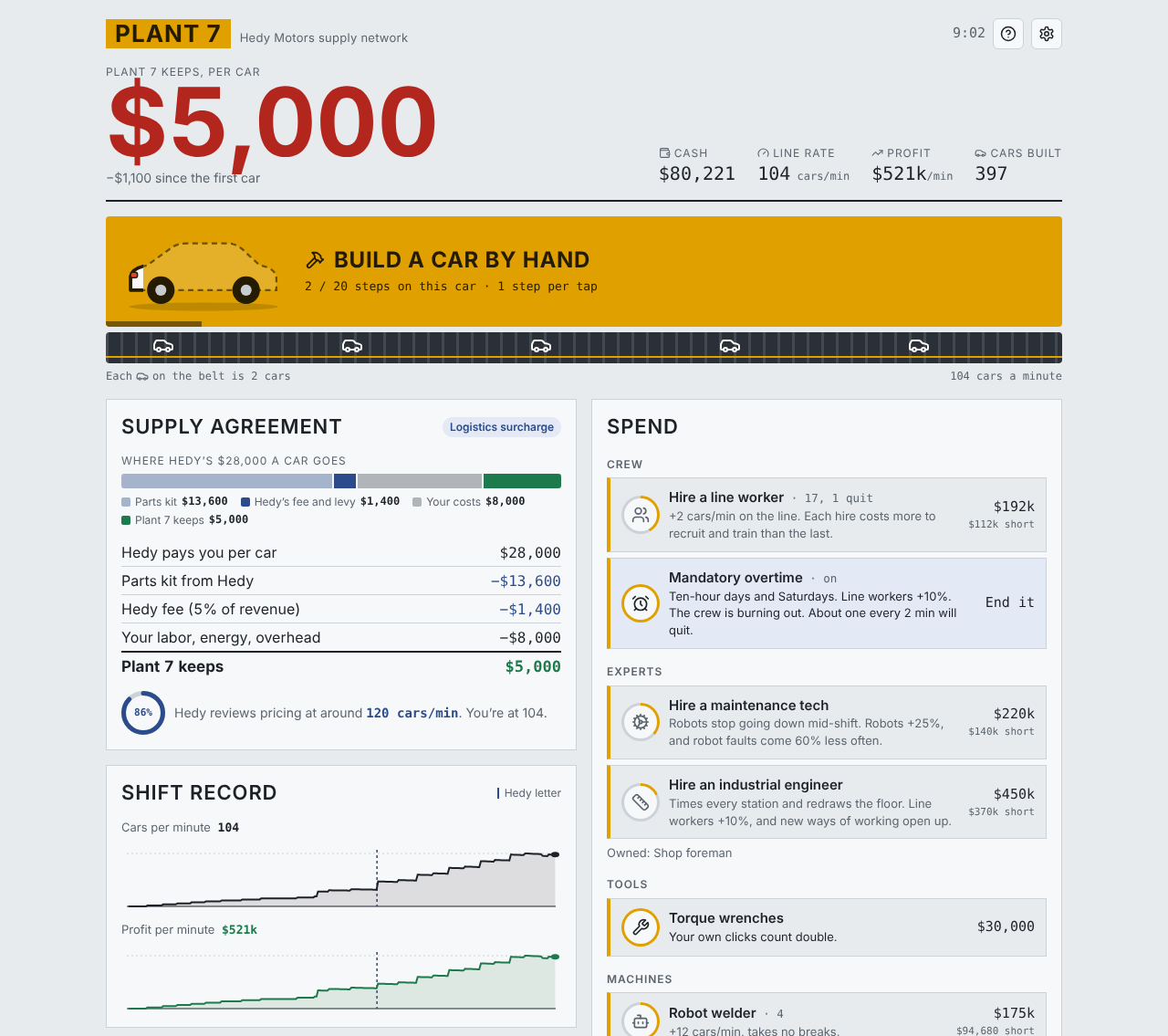
- The Build a car by hand button now shows a car that assembles as you tap, Cookie Clicker style.
- Under it, a conveyor rolls finished cars off at your real line rate and stops when the line does. Each car on the belt is a labeled batch (1, 2, 5, 10, 20, 50... cars), so it stays readable from your first car to your thirty-thousandth.
- Where each car's price goes is now a split bar: the parts kit, Hedy's cut, your costs, and what Plant 7 keeps.
- Rings show how close you are to Hedy's next price review, Hedy's share, members' trust and the buyout loan.
- Shop items have icons in rings that fill as your cash comes in, so you can see what's almost affordable.
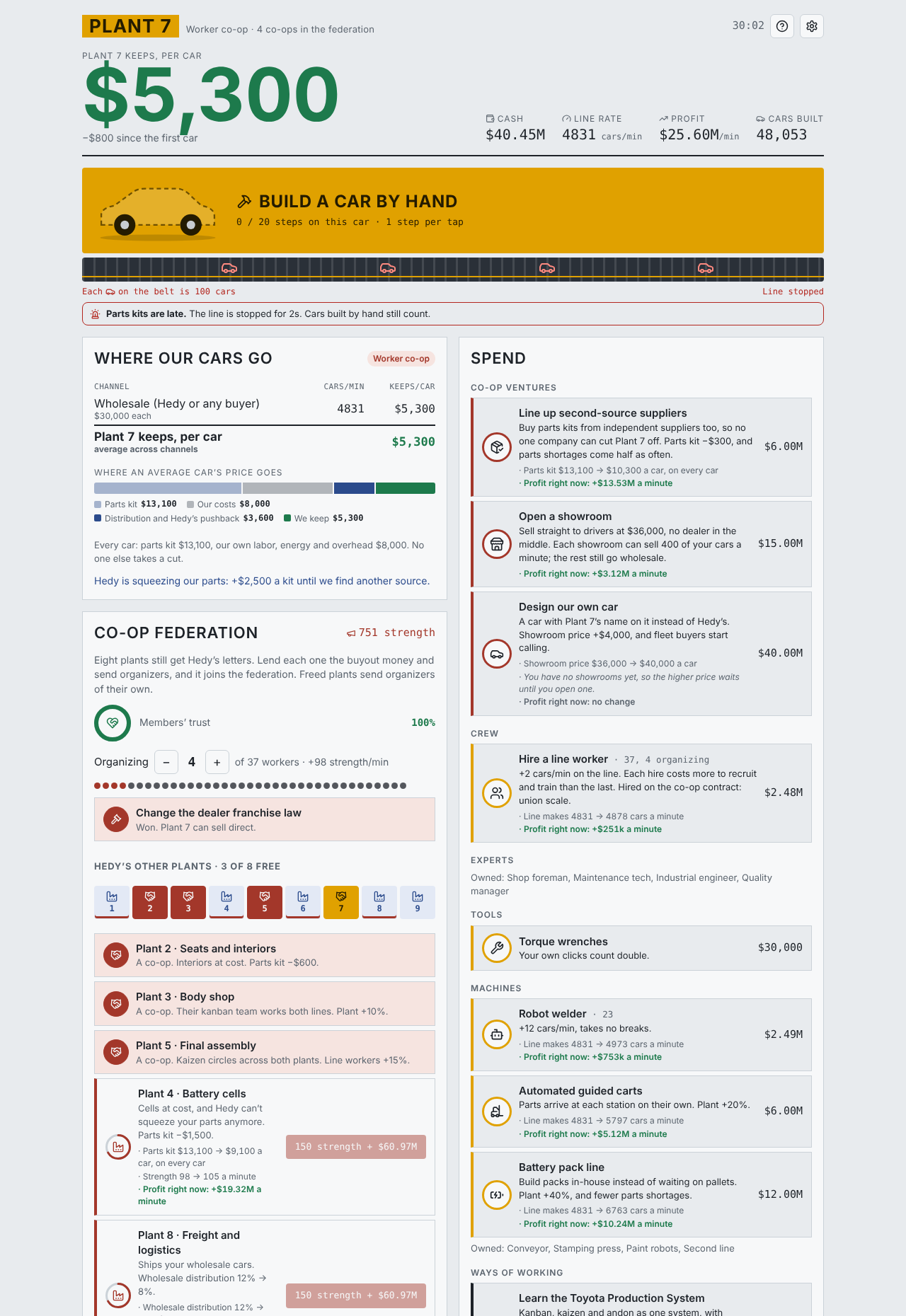
- Your crew is a row of dots, with organizers in red.
- In act 2, a map of the nine plants shows which are free, and the organizing steps get strength rings.
- Bullet graphs show how full your showrooms and fleet contracts are, and how close the federation's pay ratio is to 15 to 1.
- The act 3 surplus split is a split bar too.
- Letters get a seal and a before/after bar of what Plant 7 keeps.
Act 2 now tells you what your choices do
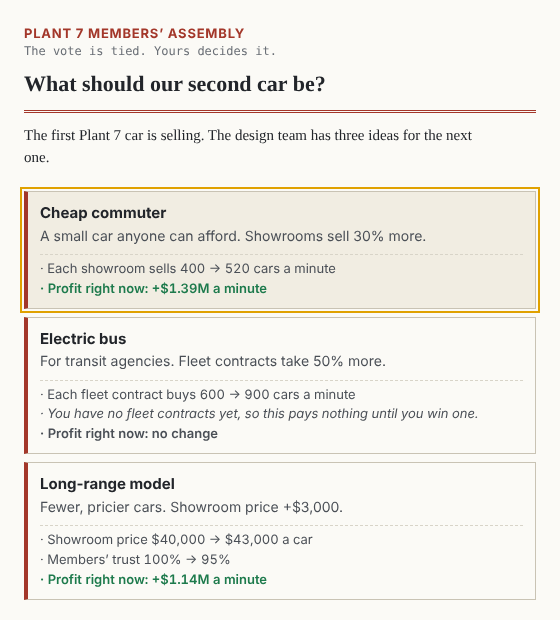
Act 2 vote options used to say things like "Fleet contracts take 50% more", which didn't tell you whether that was good for your plant. Now every vote option, sister plant and co-op shop item runs the game one step ahead and tells you the actual result: how many cars, how much each one sells for, and what it does to your profit per minute right now. If an option can't pay off yet ("You have no fleet contracts yet"), it says that too.
The sales panel also finally explains something a lot of you asked about: why profit per car goes down in act 2 while profit per minute goes up. Your showrooms and fleet contracts can only take so many cars. Everything past that sells wholesale at $6,400, so your average per car falls even as you earn more. The panel now says when your channels are full and what one more showroom or fleet contract would add.
Smaller changes and fixes
- Hedy's price review ring no longer stalls at 99%. Each run's tiers vary a little, so the panel now shows the range the next review can land in (for example 34 to 46 cars a minute), and the ring fills toward the top of it.
- Cars/min now shows what the plant is actually turning out. Cars you build by hand count (a 15-second average, with a small "by hand" line under the number), and profit and both charts include them.
- During a line stoppage, Cars/min turns red and drops by what's lost, and profit, the charts and the belt follow. Hedy's price reviews still go by your normal line rate, so a breakdown or a burst of clicking never triggers one.
- Optional sound effects: quiet cues for taps, finished cars, purchases, line stoppages, letters, votes and the win. Sound starts off; turn it on with the speaker button in the top bar, and the game remembers your choice.
- In the act 3 downturn, laying off members now idles the lines they ran, and a "Hire them back" button brings them back once orders return.
- "Ride it out on reserves" now actually pays the idle crews from the reserve fund until it runs dry.
- Federation vote cards only count down while they're on screen, one at a time, so the council can't decide before you've seen the question.
- Save image and Share on the win screens no longer throw an error.
- Lots of wording fixes, and buttons that are waiting on something now say what.
Your old save
If you've already won, your save picks up where you left off. Look for the "Go on" button on the win screen.
Thanks for playing. If you reach the town meeting, tell us which ending you got and how much of your raises you kept.
— Permadeath Media